


The Contribution of School – Based Professional Teacher Development (SBPTD) Programs in Developing Professional Competencies of School Teachers
K.W.C. Samudini1, S.S. Dahanayake1
University of Colombo, Sri Lanka
Abstract
This research aimed to study the contribution of School-Based Professional Teacher Development (SBPTD) programs in developing professional teacher competencies of school teachers. Research objectives focused on identifying the nature and specific objectives in organizing SBPTD programs in Sri Lankan schools, examining teacher attitudes regarding SBPTD activities towards professional teacher development, and finding strategies for mitigating the challenges in organizing and implementing SBPTD programs. Using the descriptive research method, the survey was used in 12 government schools that constituted 1AB, 1C, Type 2, and Type 3 Sinhala medium government schools in Kalutara district, in the Western Province. The sample consisted of 180 teachers and 30 school officials (principals and zonal education directors) involved in school administration. Data were collected through questionnaires, interviews, and documentary studies and were analyzed and interpreted using statistical tables, percentages, and t-tests. Teachers and principals identified SBPTD as an effective professional teacher competency development program. The research revealed that the teachers lacked motivation to achieve competency, although the need existed. Principals faced problems with teacher participation in SBPTD programs. Compared to the in- service programs conducted outside the school, teachers are more willing to participate in the SBPTD programs organized within the school. Out of the educational, personality, professional, and social competency areas, programs on social competencies were scarce. Programs related to the development of social competencies have been implemented at a very low level compared to the other competencies considered. School-level SBPTD programs were also not held continuously and systematically and were held amidst obstacles. Financial allocations for the implementation of SBPTD programs were insufficient. Principals also did not pay sufficient attention to time and resource personnel management. Through SBPTD programs, teachers are expected to organize a more advanced learning and teaching process at the professional level and gain competency in the legal framework of their teaching profession.
Keywords: School-Based Professional Teacher Development (SBPTD), Professional teacher competencies, Strategies, Challenges
Introduction
A person beginning as a novice teacher/enters the school system through long- term pre-service teacher education or the short-term in-service teacher education process is called a professional teacher (Ministry of Education, 2013). Teaching in the 21st century does not require a teacher who conforms to a single model or framework but a teacher with a range of creative abilities. Social expectations and curriculum content are changing, and the knowledge required to carry out the learning and teaching process through new methods requires teachers to develop throughout their careers. The teacher has to function in the school as a social institution that fulfills all the present and future expectations of the students engaged in learning.
School-Based Professional Teacher Development (SBPTD) has received worldwide attention as one of the most accepted methods for continuing teacher education. School-Based Teacher Development (SBTD) program commenced in 2005 under the Education Sector Development Framework and Program (ESDFP; 2012-2016), and SBTD programs were introduced in every school in Sri Lanka. In Sri Lanka, the Ministry of Education has also been working to introduce SBPTD programs to the school system under different names. Accordingly, this program was implemented as continuous teacher development in the beginning. Later, the concept known as School-Based Teacher Development was introduced to the school system in the year 2019 under the name of School-Based Professional Teacher Development by circular 45/2019.
The SBPTD Program was introduced to the school system in a new way in 2019 as a program included under the general education reforms implemented through World Bank support. The program introduced eight teacher competencies (Ministry of Education, 2019,p.3-4), including the following.
- Continuing professional teacher development
- Knowledge of students
- Subject knowledge and pedagogical skills
- Creation of a learning environment
- Monitoring, assessment, and evaluation process
- Rules and regulations/ethics/internalization of values
- Teacher-students and community relations
- Planning and management strategies
As Mathews (2002) reveals, the Sri Lankan government has recognized five objectives that can be achieved through school-based professional development. The second is to promote school-based teacher development programs. The next step is to facilitate teacher participation in continuing teacher education programs. Finally, principals and senior management teams should be trained in educational planning, the use of information technology, financial management, quality improvement, and the organization of effective in-service teacher development workshops.
According to Hakim (2015), professional teacher competencies have been classified into four main competencies: pedagogical, personality, professional, and social. This research also classified professional teacher competencies accordingly. Many teacher competencies could be identified in the literature review. The teaching profession competencies were identified according to the teacher competency areas identified below. Data were collected on teacher competency areas covered by SBPTD Programs implemented in the sampled schools during the years 2017-2021.
The SBPTD program aims to update and intensify the teacher’s knowledge, skills, attitudes, and practices to provide the student with an education integrated with the national educational objectives by identifying the student’s potential that is unique to each school. It is also empowering to plan and implement the programs needed to develop professional and personality qualities within the school. Accordingly, although the goal of the SBPTD Program is to make every teacher a teacher full of professional competencies, it will be important to inquire whether every school is trying to achieve that.
Theoretical Background
Ice-Berg Model
Harvard psychologist David McClelland developed the iceberg model. He believes that a person could not only do well because of the skills and knowledge but also because some of the underlying traits/competencies that influence his success at work make him a fit for the job. These behavioral traits are hidden from the human eye. According to Field & Drysdale (1991), the iceberg model for competencies takes the help of an iceberg to explain the concept of competency. An iceberg with just 20 of its volume above water, and the rest remains beneath the sea’s surface. These account for around 80 percent of a person’s competencies, but they are much more difficult to assess than skill and knowledge. Similarly, a competency has some visible components like knowledge and skills. However, other behavioral components like attitude, traits, thinking styles, self-image, organizational fit, etc., are hidden or beneath the surface.
Figure 1
Iceberg Model of competencies

Source: https://pacificexecutives.com/understanding-the-iceberg-model-of- competencies/
The iceberg model of competencies provides a useful framework for assessing individuals based on critical competencies. With a comprehensive understanding of competence, organizations and individuals can make more effective hiring, training, and development decisions.
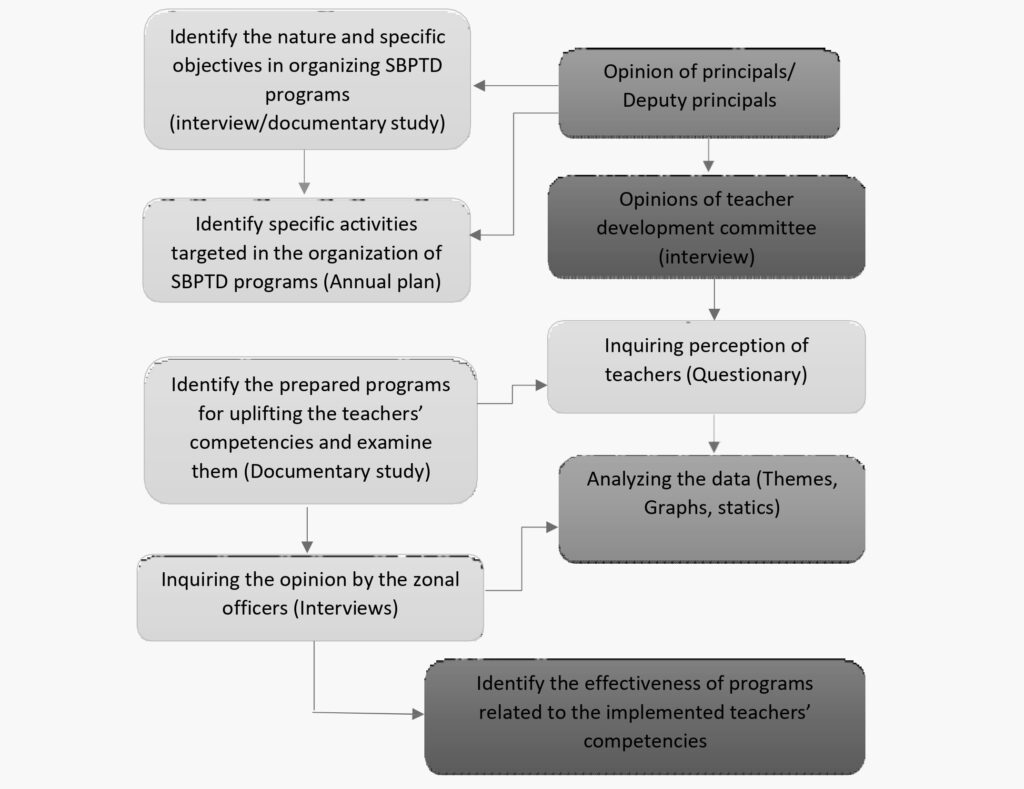
Grounded on the literature examination, the conceptual structure shown in Figure 2 was built to demonstrate the connection between elements to be investigated in the current research.
Based on this background the objectives of this study are given below.
Objectives of Research
The main purpose of this research was to study the contribution of School-Based Professional Teacher Development (SBPTD) programs in developing professional teacher competencies of school teachers. The research was conducted through four research objectives to find answers to this main research question.
- Identified the nature and specific objectives of organizing SBPTD Programs in Sri Lankan
- Identified specific activities targeted in organizing SBPTD Programs in Sri Lankan
- Examined teacher attitudes regarding SBPTD programs towards professional teacher
- Found strategies for mitigating the challenges in organizing and implementing SBPTD
Figure 2
Conceptual Structure of Research
Research Design
The descriptive research method, which is widely used for studies in the field of education, was used for this study. Because it generates answers in a statistical form, it is easy for researchers to carry out a simple statistical analysis to interpret what the data is saying. Descriptive research is a method used to determine the characteristics of a population or particular phenomenon. Surveys are descriptive research that involves collecting data through self-administered or interviewer- administered questionnaires. Additionally, they can be administered in-person, by mail, or online and collect qualitative and quantitative data. The study was conducted as a survey. Both qualitative and quantitative methods were used in the data collection and analysis of qualitative data.
Population and Sample
The population was constituted of 1AB, 1C, Type 2, and Type 3 Sinhala medium government schools in Kalutara district, in the Western Province. The sample for the study was selected from the 12 Sinhala medium government schools (1AB, 1C, Type 2, Type 3) in the Kalutara district, Zonal Education office in Horana, using the simple random sampling method. Fifteen (15) teachers were selected from each school using the random sampling method, which amounted to 180 teachers.
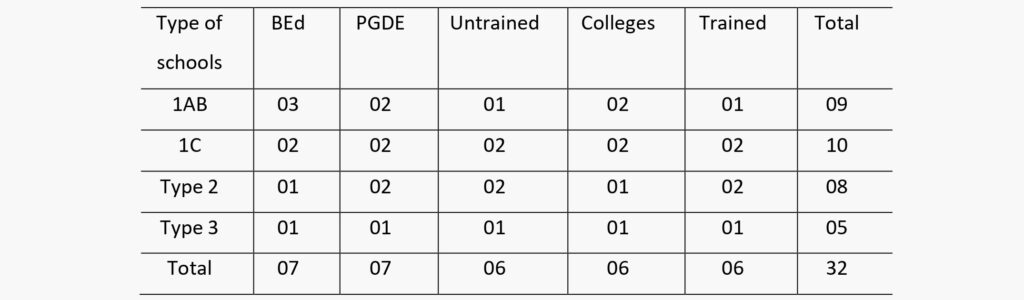
In addition, principals from 12 schools and three education officers were interviewed to collect data. Data from 180 teachers from selected schools were collected through questionnaires. A sample of 32 teachers was administered the questionnaires to establish the validity and reliability of the questionnaires.
Table 1
The sample for the study
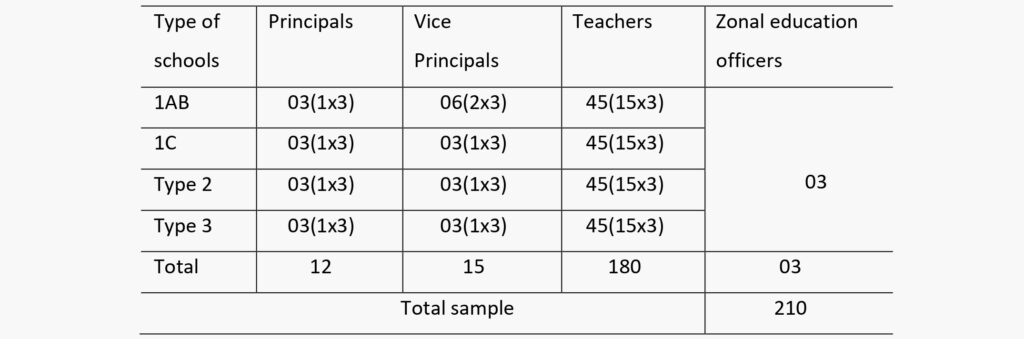
Table 2
The sample for the Pilot Test
Methodology and Data Analysis
Three research instruments were used: questionnaires, interviews, and document studies as secondary data. Data from the documents and the questionnaires were verified through interviews with selected teachers, principals, vice principals, and education officers. Issues specific to each school were identified through an in-depth analysis of data collected from the interviews. Collected data were interpreted using statistical tables and percentages.
Data collected from the questionnaires were analyzed quantitatively, while the data collected from the documentary survey and interviews were analyzed qualitatively using descriptive data analysis methods.
Findings
Results revealed the basic activities related to implementing the SBPTD Program in the school. SBPTD activities are included in the annual implementation plan. However, there is a lack of orientation toward converting the teachers’ lounge into an SBPTD room.
Table 3
Teacher competencies areas covered by SBPTD programs implemented in schools between the years 2017-2021 in schools between the years 2017-2021
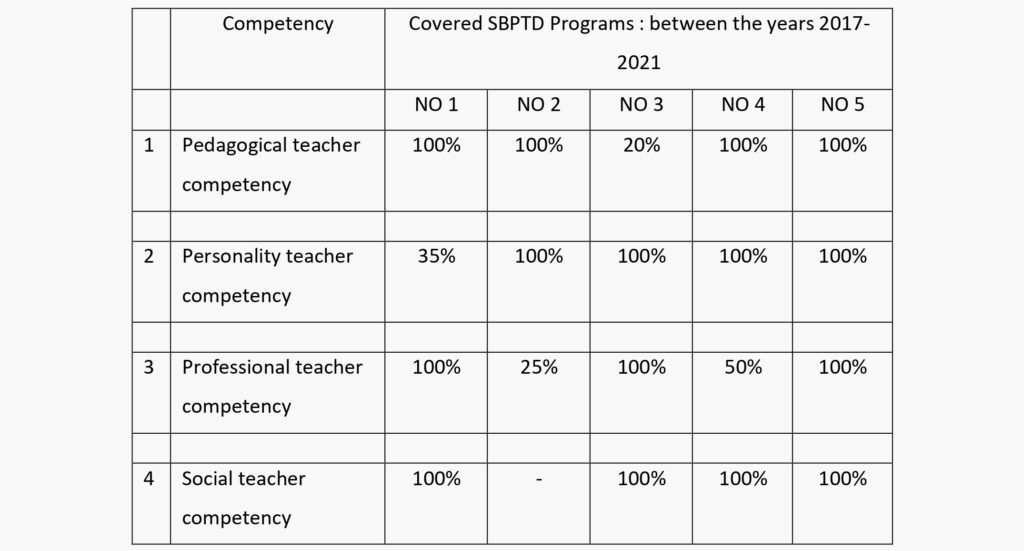
(Source: Based on the questionnaire given to the teachers)
- Pedagogical teacher competency
NO 3 – Expressing and using a higher level of cognition
- Personality teacher competency
NO 1 – Building a conflict-free, coherent learning environment
- Professional teacher competency
NO 2 – Engage in academic works and publication activities
NO 4 – Development of professional skills by research studies with priority to action researches
- Social teacher competency
NO 2 – Giving support to community welfare activities
The organization and implementation of programs related to the development of Expressing and using a higher level of cognition, Building a conflict-free, coherent learning environment, engaging in academic works and publication activities, and development professional skills through research studies with a priority to action research are shallow levels. In particular, giving support to community welfare activities was not implemented between 2017 and 2021.
The principals intervene to identify the professional problems of teachers and set priorities. The school administration looks into the professional issues of the teachers and provides necessary guidance. However, the school administration must continuously check whether the implemented SBPTD programs/activities fulfill their objectives.
In selecting SBPTD Programs, there is a minimal focus on non-financial programs. But every time the financial allocation is done, it is considered a priority task, and the necessary programs are designed and implemented.
The records of the SBPTD Program, conducted exclusively for each teacher, have yet to be maintained. Regulation and active evaluation of such programs need to be implemented. Also, the SBPTD Committee headed by the principal is not 100% responsible for the continuity of the SBPTD Programs/activities in the school and their regulation and evaluation. The SBPTD programs implemented in the school should be regularly regulated and evaluated by the Zonal Education Office.
Compared to teachers working in 1AB Schools, teachers working in 1C, 2, and Type 3 Schools need more help using technology competencies. Teachers’ participation in SBPTD programs is average, and most teachers are more willing to participate in SBPTD programs than in-school workshops. Sound practices are shared with other schools at a lower level. Implementation of SBPTD programs in schools needs to be higher.
Principals need help in implementing SBPTD Programs. It was further confirmed by conducting interviews with the principals. They are shown below.
- Insufficient time to implement such programs during school
- Non-active participation of expert teachers in
- Lack of physical, human as well as financial
- Running the programs during school hours means sacrificing students’ learning
- Many teachers expressed reluctance to stay after school for
- Inadequate interest of teachers in SBPTD
- Situations of teachers’ disobedience to the
Conclusion and suggestions
The SBPTD program is already being implemented in Sri Lankan schools in various ways.
Principals and teaching staff need to identify their professional teacher development needs in a way appropriate and relevant to the unique circumstances of one’s school. Accordingly, it is expected to implement programs for the development of effective professional teachers by supporting the already existing human and physical resources within the school and external resources in exceptional cases. According to Bandara (2018), the “key” to improving the quality of student outcomes in the 21st century is the development of professional teacher competencies. In such a situation, teachers have to update and intensify their knowledge, skills, attitudes, and practices according to the current wide demand of students.
Teachers and principals have recognized the SBPTD program as an effective teacher development tool, but more attention needs to be paid to the effective functioning of the program. Organizing special lectures by experts in the field of education on the themes of organizational activities, lesson planning, teacher discipline, and teacher attitude development has been adopted by the majority of the schools.
The teachers pointed out shortcomings of SBPTD programs, and these included the obsolete nature of the implemented programs, ineffectiveness, negative attitude of teachers towards the implemented programs, non-use of modern technology, lack of awareness about SBPTD programs, and management weaknesses of SBPTD programs. Furthermore, lack of continuity, systematic and uninterrupted implementation of programs, lack of resources and insufficient financial support, resource allocation weaknesses, and negligence of teacher needs were also revealed.
To implement SBPTD programs successfully, teachers and principals of the schools should clearly understand what these programs are and their necessity. Awareness programs for principals should be organized urgently, and a national plan should be developed to monitor the implementation of SBPTD programs. Also, networking with other schools in the area will help successfully implement SBPTD programs in a given school. Also, SBPTD programs should be implemented in a manner that does not interfere with the educational activities of the students.
Most teachers working in schools need help in their professional fields. Most of those professional problems are related to competencies related to the teaching process. It is seen that the principals act without correctly identifying the teacher needs; therefore, the teacher development needs need to be adequately addressed. To solve this, under the guidance of the principal, the school needs to create internal development opportunities.
There needs to be more orientation toward converting the teachers’ lounge into a SBPTD room. A physical plan must be prepared so the teachers can gain professionally productive experience during that time. Therefore, the principals should focus on possibly converting the teacher’s lounge into a SBPTD room as required.
Lack of continuous monitoring of the school-based SBPTD programs/activities hinders the effective continuation of the SBPTD program. Officers in the Zonal Education Office should advise the school management to conduct an annual review and ensure record keeping of SBPTD programs. This needs to be coordinated through the Zonal Education Office. School-based professional teacher development activities, as well as school managers involved, should be continuously regulated and evaluated.
Compared to teachers in 1AB schools, teachers in 1C, 2, and Type 3 schools need help using technology competencies. Therefore, teachers should be given more opportunities to develop the attitudes required to adapt to educational changes and use learning tools and technical knowledge. If these facilities are insufficient, the environment necessary for collaborative teacher competencies development between schools should be created. Also, the zonal Education officials should fairly distribute available financial allocations allocated by the government to schools to obtain the necessary physical resources.
Since the use of research methods such as task-based research is at a minimum level, efforts should be made to develop the competencies of the teaching profession by directing teachers to conduct educational research on a school basis. The number of training sessions related to SBPTD program planning should be increased. Teachers should be interested in professional skills development to act in the classroom according to the new educational trends related to social, economic, and political changes.
Arrangements should be made to provide opportunities for the principals and teachers involved in SBPTD programs to gain foreign experience. To increase participation in SBPTD programs, the possibility of issuing certificates to teachers, monitoring their practical use, and paying incentives to teachers should be explored. Also, there should be better evaluation opportunities for teachers by top management, the implemented SBPTD programs should be evaluated, and efforts should be made to organize merit awards and recognition programs for their practical use. The school management should also work to carry out teacher welfare activities, look into the personal grievances of the teachers, and provide necessary remedies so that teachers remain contented in their profession.
References
- Abeynayake, S., Neranjani, E.S. (2021). School Based Teacher Development programmes; readiness to face challenges S. Abeynayake 1 , E.S. Neranjani 2 2. 1–8.
- Alkhawaldeh, A. (2017). School-based Teacher Training in Jordan : Towards On- school Sustainable Professional Development. 19(2), 51–68. https://doi.org/10.1515/jtes-2017-0014
- Asmani, JM, 2009. Competency Exciting, Power Books. Yogyakarta.
- Bandara, S. (2018). A Review Paper On: Identified Effective Methods Which Are Used In School-Based Teacher Professional Development in Sri Lanka. International Journal of Scientific and Research Publications (IJSRP), 8(10), 248–255.
- Darmadi, H. (2016). Tugas, Peran, Kompetensi, Dan Tanggung Jawab Menjadi Guru Profesional. Edukasi: Jurnal Pendidikan, 13(2), 161–174. https://doi.org/10.31571/edukasi.v13i2.113
- Field, L. & Drysdale. D. (1991). Training for Competence. London, Kegan. P.14.
- Gedvilienė, G. (2021). The Development of Social Competence of Teachers and Students: Self- Assessment Research. Tiltai, 72(3), 91–104. https://doi.org/10.15181/tbb.v72i3.1168
- Hakim, A. (2015). Contribution of Competence Teacher (Pedagogical, Personality, Professional Competence and Social) On the Performance of Learning. The International Journal Of Engineering And Science, 4(2), 1–12. www.theijes.com
- Hamidi, M., Indrastuti, S., (2012). Influence Analysis of Competence, Educational Background on Performance Polikteknik Bengkalis Lecturer of Leadership Perspective. Proceeding of the National Seminar on industry and Technology. December 26, 2012.
- Karim, A., Kartiko, A., Daulay, D. E., & Kumalasari, I. D. (2021). The Effect of the Supervision of The Principal and The Professional Competency of Teachers on Teacher Performance in Private MI in Pacet District. Nidhomul Haq : Jurnal Manajemen Pendidikan Islam, 6(3), 497– 512. https://doi.org/10.31538/ndh.v6i3.1686
- Mathews, B. (2002). Case study on the Secondary Education Development Project. Asian Development Bank. Colombo.
- Ministry of Education (2013). Guidelines for School Based Teacher Development Program. Sri Lanka: Battaramulla.moe.gov.lk
- Ministry of Education (2019). Guidelines for School Based Professional Teacher Development Program. Sri Lanka: Battaramulla.moe.gov.lk
- Spencer, L.M and Spencer, SM, 1993. Competence at work: Models for Superior Performance. John Wiley & Sons. New York.
- Wijaya, C and T. Rusyan 1992. Ability Elementary Teachers in Learning Process. PT. Teens Rosda paper. Bandung.
- Wijekoon, K.M.J. and Kumari, H. M. L. (2021). Examining the teachers’ perception of the school -based professional teacher development programs K.M.J. Wijekoon 1 , H.M.L. Kumari 2 2. 387–392.

Editorial
Editorial International educational journals play a vital role in advancing the field of education by facilitating the dissemination of research findings, innovative practices, and theoretical advancements on a global scale. However, the number of scholarly journal publications on education in Sri Lanka is limited. Therefore, scholars in the education field in Sri Lanka […]

The Relationship between the Factors Affecting Learning- Teaching Process of Mathematics and Students’ Performance in Mathematics in Type II Schools in the Jaffna District
The Relationship between the Factors Affecting Learning- Teaching Process of Mathematics and Students’ Performance in Mathematics in Type II Schools in the Jaffna District Vartharajan Balamurali1, Sabarathnam Atrhirathan1 Faculty of Education, University of Colombo Abstract The learning-teaching process significantly impacts student achievement, but the challenges schools and teachers face contribute to ineffective learning and […]

Impact of Meditation on Teacher Immunity to Workplace Stressors
Impact of Meditation on Teacher Immunity to Workplace Stressors S.A.S. Kaushalya Perera1, Jeevani Herath2, S.D. Amarasuriya3 1Faculty of Education, Open University of Sri Lanka 2Faculty of Education, University of Colombo 3Faculty of Medicine, University of Colombo3 Abstract This study investigates the role of mindfulness meditation in enhancing teachers’ immunity to workplace stressors through a […]
The implementation nature of School-Based Management on the development of small schools in Sri Lanka
The implementation nature of School-Based Management on the development of small schools in Sri Lanka G. D. H. Kosala1, T.W.V. Indigahawela2 1Sri Jayawardenapura Zonal Education Office, Sri Lanka 2Faculty of Education2, University of Colombo, Sri Lanka Abstract The purpose of this article is to explore the implementation of School-Based Management practices related to developing […]

Unraveling the Nexus between Self-directed Learning Readiness and Academic Attainment
Unraveling the Nexus between Self-directed Learning Readiness and Academic Attainment k. Piratheeban Department of Education, University of Jaffna, Sri Lanka Abstract Despite institutional efforts, integrating self-directed learning within the Sri Lankan higher education system encounters challenges from entrenched conventional teaching practices. In response to these challenges, this correlational study adopts a quantitative approach to […]

The Influence of School Management on Strengthening the School – Community Relationship
The Influence of School Management on Strengthening the School – Community Relationship P. Sivananthan University of Colombo Abstract 0 A school is the sub-organization of a community. Both school and community are the basis for each other’s development. The school is understood as the agent undertaking the socialization process, and an organization of the […]

Academic Credential Inflation in Teacher Education in Sri Lanka: Teachers’ Perspective of the Efficacy of Master of Education Degree
Academic Credential Inflation in Teacher Education in Sri Lanka: Teachers’ Perspective of the Efficacy of Master of Education Degree V. Vijayabaskar1, L.M.K. Bandara2 University of Colombo Abstract Academic inflation theory in Education Economics relates the devaluation of university degrees due to their excessive supply to the job market. Churning out graduates with master’s degrees […]