


The Influence of School Management on Strengthening the School – Community Relationship
P. Sivananthan
University of Colombo
Abstract
0
A school is the sub-organization of a community. Both school and community are the basis for each other’s development. The school is understood as the agent undertaking the socialization process, and an organization of the community must have an effective relationship with that community. Only then will the success of both be possible. School management employed various strategies to strengthen school-community relations. The primary purpose of this study was to explore the impact of actions taken by school management on strengthening the school- community relationship. The study’s specific objectives were to measure the present status of the school-community relationship, evaluate actions taken to strengthen the school-community relationship and analyze the impact of actions the school management took on strengthening the school-community relationship. The study was conducted using a descriptive survey design. Questionnaires and documents were used to gather data. Using convenience sampling techniques, 15 principals, 15 deputy principals, and 60 teachers were selected as samples. The data was analyzed using the percentage and correlation coefficient analysis techniques. The fact-finding revealed that the schools commonly took indirect, external, direct, and neutral actions to get the active participation of the community to improve the learning achievement of the students, the effective implementation of co-curricular activities, and the improvement of moral values and welfare services for the students, yet the efficiency of such actions in strengthening the school-community relationship was at a low level. The relationship between the actions taken and the school-community relationship was a moderately positive correlation (n = 15, r = 0.5–0.6 ≤ 1). Hence, if the average score for measures aimed at strengthening the school-community relationship was low, then the average score for the present level of relationship between the school and the community was also low.
Additionally, the actions taken to strengthen the school-community relationship had a moderate impact on the present level of the school-community relationship. A committee stronger than the development committee established in schools per the Ministry of Education’s circular should be formed to enhance school- community relations effectively. This committee should consist of the principal, teachers, parents, past pupils, well-wishers, and supporters from various areas where the school is situated. It is essential to recruit members locally and internationally. Additionally, they should convene regularly to engage in fruitful discussions.
Keywords: School, Community, School – Community Relationship.
Introduction
A school community denotes personnel cooperating with the principal and teachers by involving themselves in school development activities. Thus, a school’s community can mean the principal, teachers, students, parents, alums, well- wishers, politicians, officials, health workers, government and non-governmental organizations, religious institutions, and community leaders (Anandaraj, 2016). There are two types of school communities. The principal and teachers are viewed as an internal school community, and the parents, alums, well-wishers, and other social organizations are seen as an external community. However, in view of the relationship between school and community, it generally refers to the external community.
Schools’ cooperation with the community is essential for the educational development of students (Santhanam, 2008). According to Bibire (2014), the school and community should work together to achieve their goals in education management and teaching and learning activities through discussions, and they should contribute to each other for growth and sustainability. The school should use its vast resources to strengthen, maintain, and develop the interrelationship between the school and the community. This will create a new generation in the community and build a strong foundation for restructuring education. The integration of the school and the community helps students achieve the goals of education and function the school effectively. With such integration, the school and the community can benefit (Tondeur, 2013). Therefore, it is emphasized that the role of the community in which the school is located is essential if a school is to function well.
Schools undertake the task of molding the students into better human resources who are relevant to the community and the country. Schools should be well- developed institutions, and adequate resources should be available. These resources cannot be entirely provided by the government alone. According to Sinnathamby (2008), poor countries such as Sri Lanka are in a financial crisis and cannot provide adequate funding. As a result, schools need to mobilize various funding sources for the school’s development. Economic, human, and physical resources cannot be fully provided to schools by the Ministry of Education or the Department of Education. In this context, Thanikasalampillai (2010) proposes that society should give its schools human and physical resources.
The effectiveness of the school’s management and the status of its community structure play a crucial role in determining the level of community participation (Sivananthan & Wedikandage, 2023). High community contribution and involvement can be gained through effective school management, even when the community structure is weak. Mikiko Nishimura (2017) pointed out that the bottom-up approach is an excellent solution for countries with weak administrative structures to obtain community contributions in education management effectively. Hence, community contribution can only be effectively achieved through activities carried out at the school level.
In the educational planning and management study, the National Education Commission’s (2016) report found that there needs to be more community involvement in the management of schools. Also, in the Northern Education System Review (2014) by the Northern Province Ministry of Education, one of the factors responsible for the deterioration of education in the Northern Province was identified as the gap between the community and schools. In this context, this study was conducted to analyze the impact of the measures taken by the school management to strengthen the school-community relationship on the basis of type 2 schools in the Vadamaradchy Zonal Education Office.
Objectives
- To measure the present status of the school-community relationship
- To evaluate actions taken to strengthen the school-community relationship
- To analyze the impact of actions taken by school management on strengthening the school-community relationship
Research Methods
This study was conducted using the quantitative methods approach. It responded to the research questions through several data collection methods and sample respondents: a structured questionnaire for the principals and teachers (quantitative) and school documents (quantitative).
This study was conducted using a descriptive survey design to measure the present state of the school-community relationship, evaluate actions taken to strengthen the school-community relationship and analyze the impact of actions taken by the school management on strengthening the school-community relationship. 15 type II schools in the Vadamaradchy Education Zone have been selected. Fifteen principals, 15 deputy principals, and 60 senior teachers who are members of the management team of these schools have been selected using convenience sampling. The percentage and correlation coefficient analysis techniques were used based on inferential and descriptive statistics approaches.
Data analysis
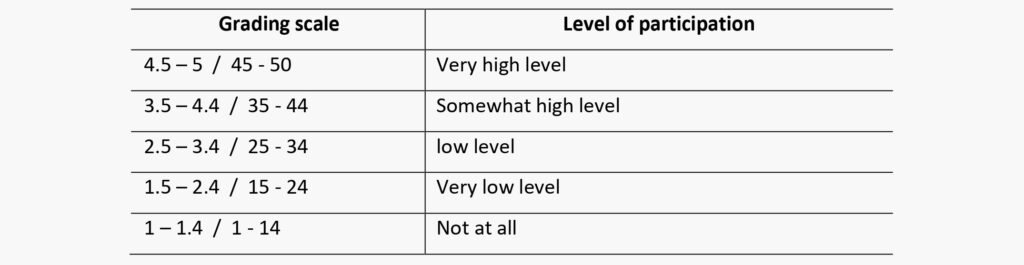
Symbols ranging from TII A to TII O have been used to represent the 15 schools chosen for the sample. For the study’s objectives, quantitative data was gathered using a Likert scale in a structured questionnaire. The data was initially divided into four components using a factor analysis. The factor-wise mean has been calculated from there. Scales have been utilized in the Likert scale, as shown in Table 1 below.
Table 1
Likert scale
To measure the present status of the school-community relationship
The following 27 variables have been considered to measure the present status of the school – community relationship. These variables were categorized into four factors using factor analysis. The first factor (F1) was the school-community relationship concerning enhancing students’ learning achievement. The second factor (F2) was the school-community relationship concerning the efficient implementation of co-curricular activities. The third and fourth factors (F3 & 4) were the school-community relationship concerning enhancing student discipline, moral values, and welfare services.
The variables considered to measure the enhancement of community participation in students’ learning achievement (F1) were as follows: Improvement of students’ daily attendance, Minimizing student lateness, cooperating with the attendance committee and the compulsory education committee, enlisting the help of the community to encourage student attendance, conducting special classes to improve achievement, Parent involvement in meetings to improve achievement, involvement in meetings of past students and other societies to improve achievement, participation of different communities, including parents, decisions taken in meetings, conducting relevant guidelines for general examination, and provision of educational equipment.
The variables considered to measure community participation for enhancing the effective implementation of co-curricular activities (F2) are as follows: Provision of appropriate trainers, assisting with the safety of the students, providing relevant advice and guidance, provision of suitable equipment, and financial assistance. The following variables were considered to measure community participation in enhancing discipline, moral values, and student welfare services (F3 & F4): Community involvement in drug prevention, acceptance of school-based punishments, adherence of the students to the discipline rules of the school, community cooperation in the prevention of cultural degradation, working in collaboration with the disciplinary committee, disaster management activities, the provision of scholarships and other social welfare assistance to students, the provision of infrastructure facilities, and the effective implementation of school health activities.
The average of these four factors was calculated and shown in Table 2 below.
Table 2
The present status of the school – community relationship
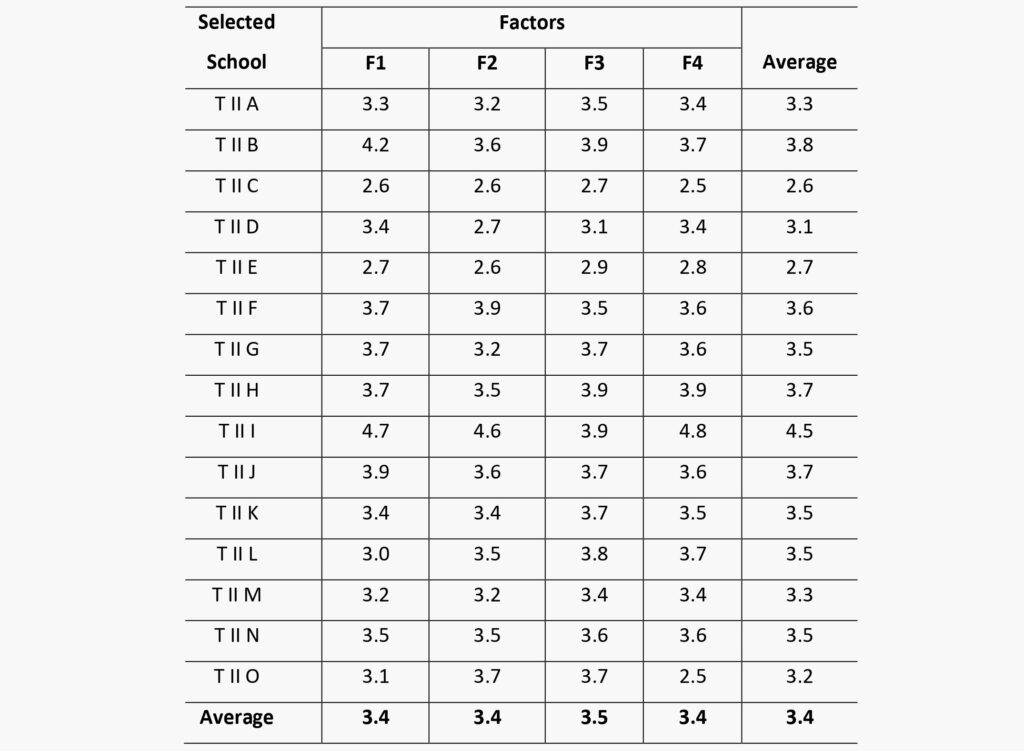
According to Table 2, the present status of the school-community relationship was
- This highlights the low level of the school-community relationship: Factor- wise, 1, 2, and 4 were at the lowest level of 3.4. However, factor 3 was at the highest level of 5.
To evaluate actions taken to strengthen the school-community relationship
The following 21 variables have been considered to measure actions to strengthen the school-community relationship. These variables were categorized into four factors using factor analysis. They were classified as indirect actions, external actions, direct actions, and neutral actions.
Indirect actions (F1) taken to strengthen the school-community relationship included:
- Conducting discussions with the community on a regular
- Instant publication of school events in the
- Creating a democratic environment in the school that can encourage community
- Inviting the community into discussions related to school development and respecting their views to establish effective communication and cooperation with various organizations in the
- Invite professionals from the community to share their experiences and advice on religious and spiritual activities.
- Developing sympathetic thoughts and helpful attitudes towards the community regarding school development.
- Making proper contact with high-income earners in society and getting their help.
- Inviting community members to school events as
External actions (F2) taken to strengthen the school-community relationship included:
- Enlisting the help of classmates through social media to work as a
- Creating a social website for the school and establishing effective communication with people in the country and
- Organizing awareness activities related to contemporary issues in collaboration with the
- Providing opportunities for students to participate in community arts and cultural events.
Direct actions (F3) taken to strengthen the school-community relationship included Honoring those in the community who have contributed to the school’s development, Getting advice from experts in the community where necessary, active participation of the principal, teachers, and students in the community events; giving some responsibilities for school events to the community; and providing the community with the school’s resources that the community expects to use. Neutral actions (F4) taken to strengthen the school-community relationship included Being transparent in finances and working with the neutrality of caste, religion, and class differences.
The average of these four factors was calculated and shown in Table 3 below.
Table 3
Actions taken to strengthen the school – community relationship
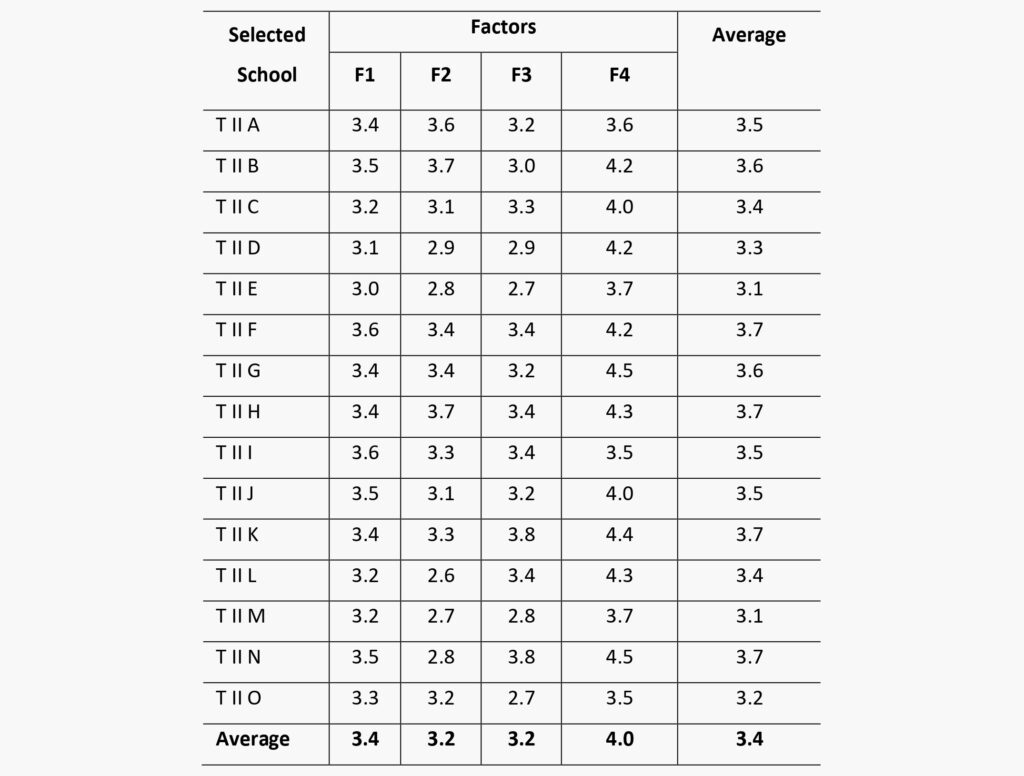
According to Table 3, the mean value of actions taken to strengthen the school- community relationship was 3.4. The data indicated that the actions taken to strengthen the school-community relationship were low. However, looking at factors, F4 (Neutral activities to enhance the relationship of school-community) had a high score of 4.0. F1, 2, and 3 (indirect, external, and direct activities to strengthen) had a low average score of 3.3.
To analyze the impact of actions taken by school management on strengthening the school-community relationship
The correlation between these was calculated using the mean of the actions taken by school management to strengthen the school-community relationship as the independent variable and the four factors related to the present status of the school-community relationship (students’ learning achievement, effective implementation of co-curricular activities, students’ discipline and moral values, and welfare services) as the dependent variable. The correlations between these were calculated using Spearman’s correlation method due to the data related to two variables as ordinal values.
Zakaria Jaadi (2019) indicated how to interpret a correlation coefficient’s size (strength) through the table below. Based on this, the relationship between these two variables was explained.
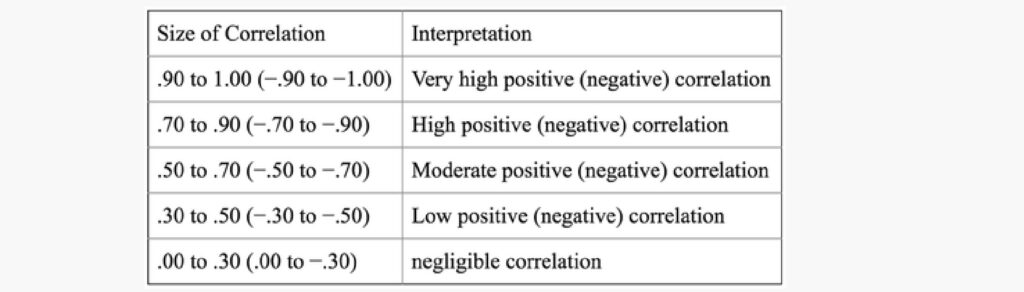
Table 4
Correlations between the school – community relationship and actions taken by school management for strengthening the relationship
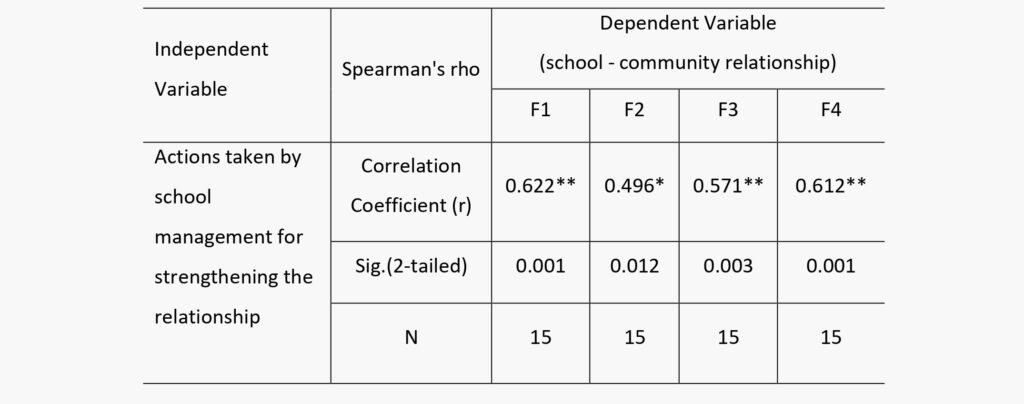
**Correlation is significant at the 0.01 level (2-tailed).
*Correlation is significant at the 0.05 level (2-tailed).
According to Table 4, the significant value of factors (F1, F3, and F4) was calculated at the 0.01 level and F2 at the 0.05 level. The considerable value between the dependent (F1, F3, F4) and the independent variable was smaller than at 0.01. The correlation coefficient had statistical significance as a result.
The independent and dependent variables (F1, F3, and F4) correlated between 50% and 70%. As a consequence, the actions taken by school management on strengthening the school-community relationship had a moderate positive impact on the factors F1, F3, and F4. However, the independent and dependent variables F2 correlated between 49.6%. As a result, the actions taken by the school management to strengthen the school-community relationship had a low positive impact on the factors.
Consequently, school management’s actions on strengthening the school- community relationship had a moderately positive influence on the school- community relationship for improving students’ learning achievement, discipline and moral values, and welfare services. However, the effective implementation of co-curricular activities had a low positive impact.
Finding Discussion and Conclusions
Of the four factors related to measures taken to strengthen the school-community relationship, factor 4 was rated high, while factors 1, 2, and 3 were rated low. Therefore, the data analysis indicated that the average score for measures to strengthen the school-community relationship was low.
The present level of relationship between school and community was assessed based on four factors. Factors 1, 2, and 4 were found to be low, while only factor 3 was rated as high. As a result, the data analysis revealed that the average score for the present level of relationship between school and community was low. Also, there was a moderately positive correlation between the actions taken to strengthen the school-community relationship and the present level of relationship between the school and the community.
Hence, if the average score for measures aimed at strengthening the school- community relationship was low, then the average score for the present level of relationship between the school and the community was also low. Additionally, the actions taken to strengthen the school-community relationship had a moderate impact on the present level of the school-community relationship.
According to Bibire (2014), the school and community must collaborate to achieve their goals in education management and teaching and learning activities through discussions, contributing to each other’s growth and sustainability. Tata Umar Sa’ad (2014) highlighted in their research that this interaction was crucial for the success of both. Hence, the practical relationship between the school and the community relies on the schools’ activities. Therefore, effective communication between schools and communities can be established by utilizing various strategies.
Suggestions
Catherine Hands (2015) emphasized that creating and maintaining suitable groups by the school and the community is crucial for fostering effective interaction. Therefore, this study suggests a universal strategy for all schools to establish a committee of members from the school community. This committee, comprising the principal, teachers, parents, past pupils, well-wishers, and supporters, aims to build a solid and enduring bond between the school and the community.
Also, according to the Ministry of Education circular, this committee should be more robust than the development committee set up in schools. The school development committee consists of the principal, teachers, parents, and past pupils. However, this committee should encompass parents, past pupils, and well- wishers from various parts of the area where the school is located. They should not only recruit members locally but also internationally. Moreover, they should meet on a regular schedule and participate in productive discussions.
Reference
- Anantharaj, N. (2016), School Administrative Systems, Guru Printers, Thirunelvely.
- Bakwai (2013). Assessment of the role of school community relationship in the development of secondary education in Zamfara State,Retrieved from https://www.researchgate.net/publication/322434072
- Bibire (2014). The Relevance of School Community Relationship on the Development of Primary Education in Azare Metropolis of Bauchi State,Nigeria.Retrivedfrom https://www.iosrjournals.org/iosr- jrme/papers/Vol 4%20Issue-6/Version-2/E04622329.pdf.
- Catherine Hands. (2015). Creating Links between the School and the Community Beyond its Walls: What Teachers and Principals Do to Develop and Lead School-Community Partnerships. Retrieved from https://www.researchgate.net/publication/318746351.
- Karunanithy, M. (2008), Educational Sociology, Kumaran Book House, Colombo 12.
- Mikiko Nishimura. (2017). Community Participation in School Management in Developing Countries. Retrieved from https://docs.edtechhub.org/lib/ZM3Y87L2.
- National Education Commission Report, (2016). Retrieved from www.nec.gov.lk.
- Northern Education System Review (2014). Northern Province Ministry of education, Cultural Affairs, Sports and Youth Affairs. Jaffna. ISBN 978-0-692-24907-9.
- Santhanam,S. (2007). Education and community, Santha publisher. Chennai.
- Sinnathamby, M. (2008). Education and community,Kumaran Book House, Colombo – Chennai.
- Sivananthan p., Wedikandage L.,(2023) The Impact of Community Contribution on the Academic Achievement of Students, International Journal of Research and Innovation in Social science, ISSN NO. 2454-6186, Volume VI, Issue X, https://dx.doi.org/10.47772/IJRISS.2023.701179
- Thanihasalampillai, N. (2010), The development of rural schools in the north of Sri Lanka, Published by Kumaran book house, Colombo 10.
- Tata Umar Sa’ad. (2014). The Relevance of School Community Relationship on the Development of Primary Education in Azare Metropolis of Bauchi State, Nigeria. Retrieved from https://www.researchgate.net/publication/284456966.
- Tondeur, N. (2013). Roles, Duties and Responsibilities of School Management Team: Training Manual for Secondary Schools Managers. Retrieved from http://www.rencp.org/wp-content/uploads/2010/06/MINEDUC- Administration-of-Secondary-Schools.pdf.
- Zakaria Jaadi, (2019). Everything you need to know about interpreting correlations, Retrieved from https://towardsdatascience.com/eveything-you-need-to-know- about-interpreting-correlations-2c485841c0b8.

Editorial
Editorial International educational journals play a vital role in advancing the field of education by facilitating the dissemination of research findings, innovative practices, and theoretical advancements on a global scale. However, the number of scholarly journal publications on education in Sri Lanka is limited. Therefore, scholars in the education field in Sri Lanka […]

The Relationship between the Factors Affecting Learning- Teaching Process of Mathematics and Students’ Performance in Mathematics in Type II Schools in the Jaffna District
The Relationship between the Factors Affecting Learning- Teaching Process of Mathematics and Students’ Performance in Mathematics in Type II Schools in the Jaffna District Vartharajan Balamurali1, Sabarathnam Atrhirathan1 Faculty of Education, University of Colombo Abstract The learning-teaching process significantly impacts student achievement, but the challenges schools and teachers face contribute to ineffective learning and […]

Impact of Meditation on Teacher Immunity to Workplace Stressors
Impact of Meditation on Teacher Immunity to Workplace Stressors S.A.S. Kaushalya Perera1, Jeevani Herath2, S.D. Amarasuriya3 1Faculty of Education, Open University of Sri Lanka 2Faculty of Education, University of Colombo 3Faculty of Medicine, University of Colombo3 Abstract This study investigates the role of mindfulness meditation in enhancing teachers’ immunity to workplace stressors through a […]
The implementation nature of School-Based Management on the development of small schools in Sri Lanka
The implementation nature of School-Based Management on the development of small schools in Sri Lanka G. D. H. Kosala1, T.W.V. Indigahawela2 1Sri Jayawardenapura Zonal Education Office, Sri Lanka 2Faculty of Education2, University of Colombo, Sri Lanka Abstract The purpose of this article is to explore the implementation of School-Based Management practices related to developing […]

Unraveling the Nexus between Self-directed Learning Readiness and Academic Attainment
Unraveling the Nexus between Self-directed Learning Readiness and Academic Attainment k. Piratheeban Department of Education, University of Jaffna, Sri Lanka Abstract Despite institutional efforts, integrating self-directed learning within the Sri Lankan higher education system encounters challenges from entrenched conventional teaching practices. In response to these challenges, this correlational study adopts a quantitative approach to […]